
Sportswear Fabric GSM Chart.
A one-page printable chart of typical fabric weights by garment and by fabric family, with hand-feel notes and a simple way to check GSM yourself.
Published — True Fit Sportswear Team
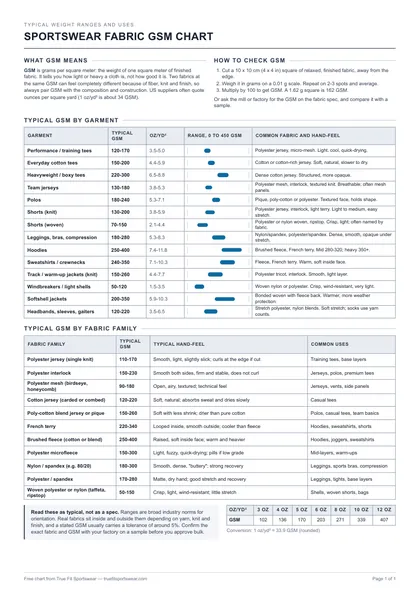
Sportswear Fabric GSM Chart
Typical GSM and ounce ranges for fourteen garment types and eleven fabric families, with a conversion strip and a how-to-check box.
Download the PDFOpens and prints from any PDF reader. No email address needed.
What The Chart Gives You
Most people start a fabric conversation with a single question: how heavy should this be? The chart answers it in two ways. The first table works from the garment, so you can see at a glance where a performance tee, a pair of leggings or a hoodie usually sits on the weight scale. The second works from the fabric family, so if you already know you want French terry or a polyester interlock you can see the range that fabric normally comes in and how it tends to feel. A small conversion strip handles ounces per square yard for anyone working from a US supplier sheet.
Every range on the chart is labeled typical. They are broad, widely used industry ranges, meant to get you to a sensible starting point and to help you spot a brief that does not add up, such as a "lightweight" leggings fabric at 120 GSM. They are not True Fit specifications, and no two mills weave or knit exactly alike. For a plain-language explanation of what the number measures, read our GSM and fabric weight guide; this page adds the reference tables and the measuring method.
Typical GSM By Garment
| Garment | Typical GSM | Common fabric | Hand-feel and use |
|---|---|---|---|
| Performance or training tees | 120-170 | Polyester jersey, micro-mesh | Light, cool, quick-drying |
| Everyday cotton tees | 150-200 | Cotton or cotton-rich jersey | Soft, natural, slower to dry |
| Heavyweight or boxy tees | 220-300 | Dense cotton jersey | Structured and more opaque |
| Team jerseys | 130-180 | Polyester mesh, interlock, textured knit | Breathable, often with mesh panels |
| Polos | 180-240 | Pique, poly-cotton or polyester | Textured face that holds its shape |
| Shorts, knit | 130-200 | Polyester jersey, interlock, light terry | Light to medium, easy stretch |
| Shorts, woven | 70-150 | Polyester or nylon woven, ripstop | Crisp and light, often named by fabric |
| Leggings, sports bras, compression | 180-280 | Nylon/spandex, polyester/spandex | Dense, smooth, opaque under stretch |
| Hoodies | 250-400 | Brushed fleece, French terry | Midweight around 280-320, heavy 350 and up |
| Sweatshirts and crewnecks | 240-350 | Fleece, French terry | Warm, soft inside face |
| Track or warm-up jackets, knit | 150-260 | Polyester tricot, interlock | Smooth, light layer |
| Windbreakers and light shells | 50-120 | Woven nylon or polyester | Crisp, wind-resistant, very light |
| Softshell jackets | 200-350 | Bonded woven with fleece back | Warmer, more weather protection |
| Headbands, sleeves, neck gaiters | 120-220 | Stretch polyester, nylon blends | Soft stretch (socks are usually specified by yarn and needle count, not GSM) |
Typical GSM By Fabric Family
| Fabric family | Typical GSM | Typical hand-feel | Common uses |
|---|---|---|---|
| Polyester jersey (single knit) | 110-170 | Smooth, light, slightly slick | Training tees, base layers |
| Polyester interlock | 150-230 | Smooth both sides, firm, does not curl | Jerseys, polos, premium tees |
| Polyester mesh (birdseye, honeycomb) | 90-180 | Open, airy, technical | Jerseys, vents, side panels |
| Cotton jersey | 120-220 | Soft, natural, absorbent | Casual tees |
| Poly-cotton blend jersey or pique | 150-260 | Soft with less shrink, drier than cotton | Polos, casual tees, team basics |
| French terry | 220-340 | Looped inside, smooth outside | Hoodies, sweatshirts, shorts |
| Brushed fleece | 250-400 | Raised, soft, warm | Hoodies, joggers, sweatshirts |
| Polyester microfleece | 150-300 | Light and fuzzy, quick-drying | Mid-layers, warm-ups |
| Nylon/spandex | 180-300 | Smooth, dense, strong recovery | Leggings, sports bras, compression |
| Polyester/spandex | 170-280 | Matte, dry hand, good recovery | Leggings, tights, base layers |
| Woven polyester or nylon | 50-150 | Crisp, light, little stretch | Shells, woven shorts, bags |
Ounce conversions for supplier sheets: 1 oz per square yard is about 33.9 GSM, so 4 oz is about 136 GSM, 6 oz about 203, 8 oz about 271, 10 oz about 339 and 12 oz about 407.
How To Check GSM Yourself
You can get a useful estimate at home with a ruler, scissors and a kitchen or jewelry scale that reads to 0.01 g.
- Prepare the fabric. Use finished fabric that is relaxed, not stretched, and has not been recently ironed flat or steamed. Keep away from the selvedge, ribbing, seams and prints.
- Cut a 10 cm by 10 cm square. A paper template and a sharp blade give a more accurate edge than scissors alone. A circular GSM cutter makes this faster if you do it often.
- Weigh it. Record the weight in grams to two decimals.
- Repeat in two or three places and average. Fabric weight varies across a roll, and the average is more trustworthy than one reading.
- Multiply by 100. A 10 cm square is one hundredth of a square meter, so grams times 100 is GSM.
Our fabric guide describes the 20 cm version of the same idea. The 10 cm square needs a more sensitive scale but wastes less fabric, which matters when you are cutting into a sample you want to keep.
A Worked Example
Illustrative example only. You cut three 10 cm squares from a sample tee and they weigh 1.60 g, 1.64 g and 1.62 g. The average is 1.62 g, so the fabric is about 162 GSM.
Allowing a typical tolerance of about 5%, the real figure could sit anywhere between roughly 154 and 170 GSM. Against the chart, that fits comfortably inside the performance tee range (120-170) and the team jersey range (130-180). It also sits at the low end of the everyday cotton tee range (150-200), and it would be too light for leggings, which usually start around 180.
Two further checks turn the number into a decision. First, stretch a corner over your knuckle in good light: if the knit opens up and you can see skin, it will look sheer on the body whatever the GSM says. Second, wash the swatch once and weigh it again, because shrinkage and finish changes can move the figure.
Common Mistakes When Reading A GSM Chart
- Treating a range as a promise. The chart shows where fabrics typically sit. Your own supplier's fabric may be slightly outside it and still be perfectly good.
- Cutting from stretched or curled fabric. A knit that was pulled while you marked it will not be a true 10 cm square once it relaxes. Let the fabric rest, then check the square's size before you weigh it.
- Comparing greige and finished weights. Fabric weight changes after dyeing and finishing. Always compare finished-fabric figures with each other.
- Assuming heavier means better. A 300 GSM fabric is the wrong choice for a summer running tee however good the yarn is.
- Ignoring construction. A polyester mesh and a polyester interlock can share a GSM and behave completely differently. Name the construction as well as the number.
- Skipping the sample. A chart narrows the field; only a sample in your hands tells you whether the fabric feels right.
Using The Chart With Your Own Brief
Pick your garment in the first table to find a starting range, then check the fabric family table to see which constructions live in that range. Write the result into the fabric box of your tech pack as a composition, a target weight and a construction, for example "polyester interlock, around 150 GSM". If you are making hoodies or leggings, our hoodie and leggings pages show what those categories involve, and the size and measurement guide covers the fit side of the same decision.
At True Fit we source fabric to your specification, then confirm the exact fabric and GSM with you before the sample is made. Samples have no minimum quantity and typically take 8–10 days, so confirming the weight on a real piece is quick; see our samples page. Always confirm the final GSM with the factory on a sample before you approve bulk.
Cite Or Link To This Resource
You are welcome to link to this page from your own site, newsletter, course notes or team handbook. Linking to the page, rather than copying the file, means your readers always get the current version. Here is ready-made link markup:
Plain-text version: Sportswear fabric GSM chart (free PDF), True Fit Sportswear, https://truefitsportswear.com/resources/fabric-gsm-chart