
Free Tech Pack Template For Sportswear.
A clean, printable nine-page A4 template that gathers everything a factory needs to quote, sample and produce a garment. Type into it on screen or fill it in by hand.
Published — True Fit Sportswear Team
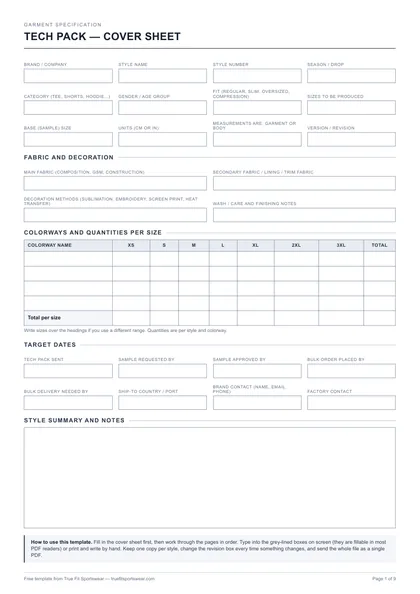
True Fit Tech Pack Template
Cover sheet, flat sketches, points of measure, bill of materials, colorways, labels, grading grid and approvals in one file.
Download the PDFOpens and prints from any PDF reader. No email address needed.
What This Template Is, And Who It Is For
A tech pack is the document a factory builds from. This template is a blank, brand-neutral version you can reuse for every style: a tee, a pair of shorts, a hoodie or a full team kit. It is made for founders putting together a first collection, coaches ordering club wear, and designers who want a consistent format across seasons. It is not tied to any one manufacturer, so you can send the finished file to any factory you are comparing.
If you want the reasoning behind each section, our guide to creating a tech pack explains what a good one contains. This page is the practical companion: the form itself, plus advice on filling it in without leaving gaps.
What Is Inside, Page By Page
- Cover sheet. Style name and number, season, category, fit, fabric, decoration methods, colorways with a quantity-by-size table, and target dates.
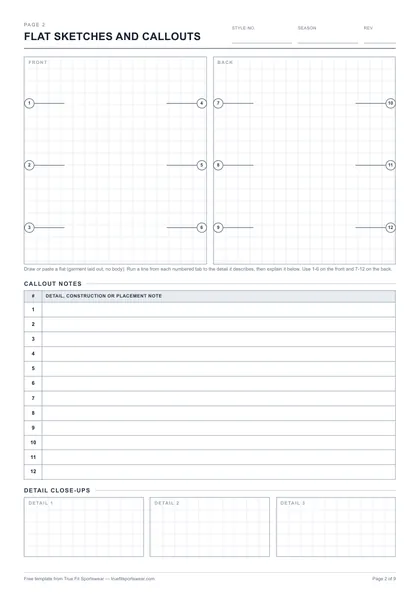
- Flat sketches and callouts. Front and back boxes with twelve numbered callout tabs, a notes table keyed to those numbers, and three close-up boxes.
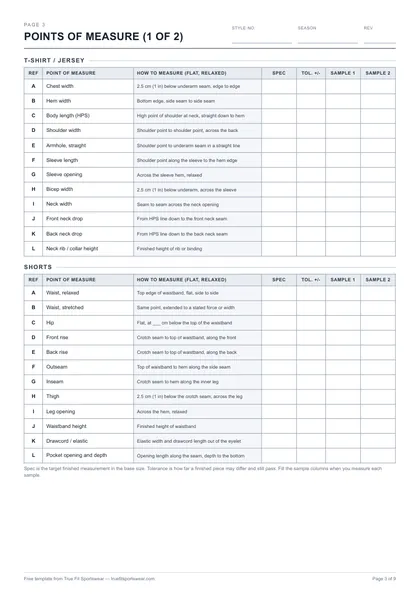
- Points of measure, part one. Tee or jersey and shorts, each with a "how to measure" column and blank spec, tolerance and two sample columns.
- Points of measure, part two. Leggings and hoodie or sweatshirt, laid out the same way.
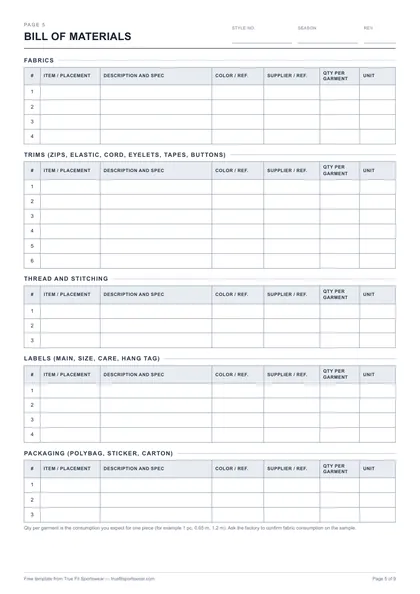
- Bill of materials. Fabrics, trims, thread, labels and packaging, each with supplier, color reference and consumption per garment.
- Colorways and prints. Swatch boxes for each colorway and an artwork table giving size, position and method for every graphic.
- Labels and packaging. Label positions, fold and pack sketch, polybag, carton and shipping marks.
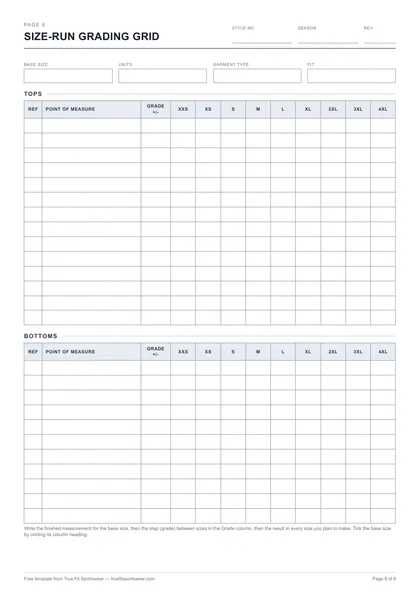
- Size-run grading grid. A base size, the step between sizes and the finished measurement in every size from XXS to 4XL, for tops and bottoms.
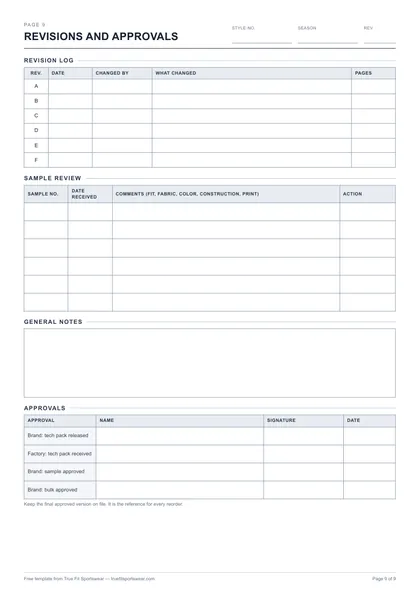
- Revisions and approvals. A revision log, a sample review table, general notes and sign-off lines for brand and factory.
Page Previews
How To Fill It In, Step By Step
- Decide your units and your base size first. Write them on the cover sheet before anything else. Every number later in the file depends on them.
- Choose one measurement basis. Write "garment" or "body" in the cover sheet box and stick to it. The size guide linked below shows the difference with diagrams.
- Draw the flats, then number the callouts. A hand sketch, a traced photo or a flat exported from design software all work. Put a callout tab on every seam, trim or detail you care about, and describe each one in the notes table.
- Fill the points of measure for your base size only. Add the spec, then a tolerance, even a provisional one. Leave the sample columns blank until a sample arrives.
- List every material in the bill of materials, including the small ones: thread, labels, polybag. A missing line is a missing cost.
- Give each print a position, not a description. Use a size and a distance from a fixed point on the colorway and print page.
- Grade last. Once the base size is approved, fill the grading grid so the whole size range follows from it.
- Keep the revision box honest. Change the letter and log what changed each time you edit the file.
A Worked Example: A Plain Training Tee
Illustrative example only. This is not a real order or a recommended specification.
Imagine a brand called "Example Athletics" filling in the template for a short-sleeve training tee, style number ET-100, in a regular fit, base size M, measured in centimeters on the finished garment.
| Page | What goes in the box | Example entry |
|---|---|---|
| Cover | Main fabric | 100% polyester interlock, 150 GSM, wicking finish |
| Cover | Decoration | Heat-transfer logo on chest, printed neck label |
| Flats | Callout 3 | Flatlock seams at shoulder and side, 1 cm wide neck rib with twin needle top-stitch |
| Measure | A, chest width, spec / tolerance | 52.0 cm / +/- 1.0 cm |
| Measure | C, body length (HPS), spec / tolerance | 71.0 cm / +/- 1.0 cm |
| BOM | Thread | Polyester core-spun, color-matched to body, one color per colorway |
| Prints | Art 1 position | 8 cm wide, centered, 7 cm below the neck seam, 4 ink colors |
Notice what the example does. Every measurement carries a tolerance, every print has a size and a fixed reference point, and the fabric entry names a composition, a weight and a finish. A factory reading this does not have to guess, so the first sample is a test of the design rather than of the brief.
Mistakes That Quietly Undo A Good Tech Pack
- Leaving tolerance blank. Without a tolerance, nobody can say whether a finished garment passes. Even a placeholder gives both sides something to measure against.
- No base size. If the file never says which size the sample represents, the measurements cannot be checked.
- Mixing units. Centimeters on one page and inches on another is an easy slip when you paste from different sources.
- Callouts that do not match the notes. If callout 5 on the sketch is a pocket and note 5 describes a hem, the factory will follow the note and be right to do so.
- Forgetting consumption. A bill of materials without quantities hides the real material cost until quoting is nearly done.
- Editing without logging. Quietly overwriting a spec means the sample you approved and the file you sent no longer agree.
- Sending an editable file only. Export a PDF so fonts and layout stay put, and send images, logos and swatch photos alongside it.
Typing Versus Printing
The boxes in the PDF are fillable in most desktop PDF readers and in many browsers, so you can type straight into them and save a copy per style. Names for the files help: put the season, style number and revision letter in the file name, for example "ET-100-rev-B". If you prefer paper, print at actual size on A4 (or fit to Letter if you are in the US) and write in pen, then photograph or scan each page. Either way works. A legible hand-filled page is more useful than a polished one with blanks.
Two companion downloads pair well with this one. The size and measurement guide shows exactly how to take each point of measure on the pages above, and the fabric GSM chart helps you choose a sensible weight for the fabric box on the cover sheet.
What Happens When You Send It To Us
You do not have to use our template to work with us, and you do not have to fill every box. Send whatever you have and our team will point out what is missing before anything is cut. We are a hand-run factory in Sialkot, Pakistan, and we make custom pieces under your own label (see private label for how that works). Samples have no minimum quantity and typically take 8–10 days; see the samples page for how to order one. Bulk orders start at 20 pieces per style and take about 18 working days after approvals, with shipping included in the quote. Every order gets a live tracking page, and our quality control page explains how orders are checked before they ship.
Making a first tee collection? Our t-shirt range shows the styles most brands start from, and our sizing and grading guide goes deeper on the grading grid.
Cite Or Link To This Resource
You are welcome to link to this page from your own site, newsletter, course notes or team handbook. Linking to the page, rather than copying the file, means your readers always get the current version. Here is ready-made link markup:
Plain-text version: Free tech pack template for sportswear (PDF), True Fit Sportswear, https://truefitsportswear.com/resources/tech-pack-template