Quality Control Checklist For Custom Sportswear Orders.
What to check at each stage, from fabric to final packing, what evidence to ask for, and how to sign off an order without guessing.
Published — True Fit Sportswear Team
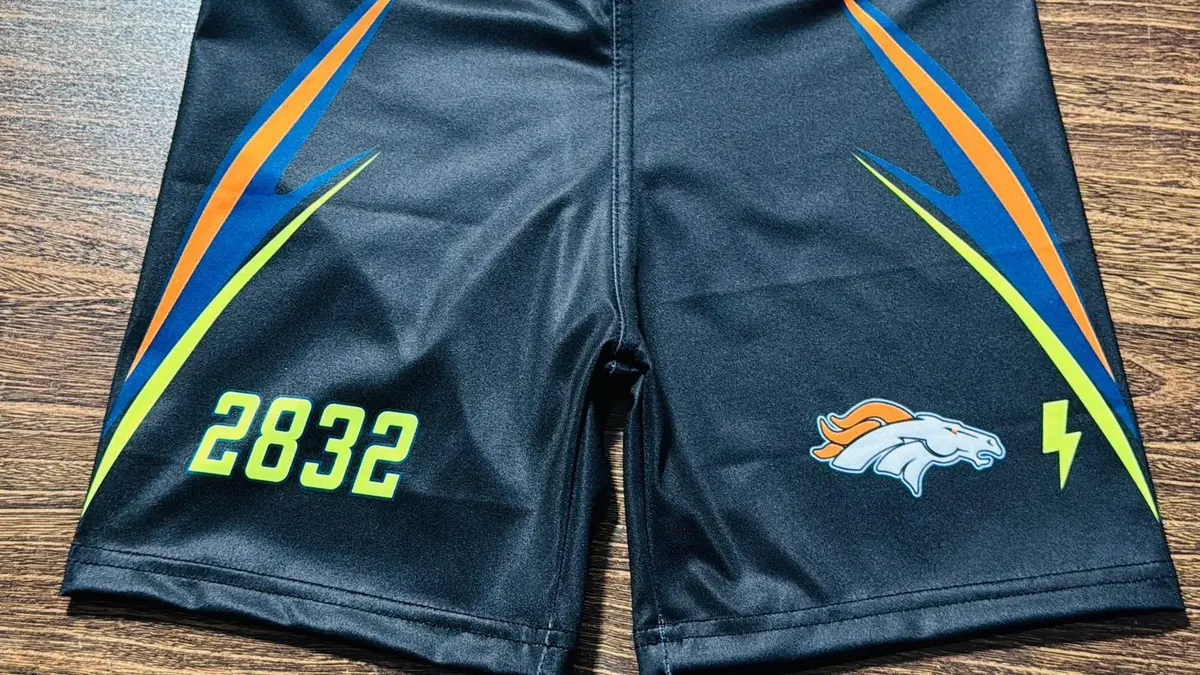
A finished piece laid flat. Seams, waistband, print placement and finish are all checkable from a clear photo.
Start With A Written Spec, Then Check In Stages
The short version: check a custom sportswear order in four stages (fabric, cutting and stitching, print and embroidery, then trims, measurements and packing), always against a written specification and the approved sample, and ask for photos or video at every stage instead of waiting for the finished boxes.
A fault caught at the cutting table costs a few minutes. The same fault caught after 200 garments are stitched, printed and packed costs a lot more, in time and in goodwill. That is why a quality control plan is about checking at stages, not only at the end.
You do not need a technical background to do this. You need a written specification to check against, clear photos or video from each stage, and a short list of things to look at. This guide gives you the list, and you can copy it into your own notes and reuse it on every order.
You cannot judge "wrong" without a definition of "right", so get the specification in writing before sampling: fabric composition and weight, colors, construction details, sizes and measurements, decoration method and placements, labels and packing. A reference garment and an agreed size chart make this much easier. Our tech pack guide shows what to include, and a tech pack is optional.
Everything below is checked against that spec and against the approved sample. If you want to know how the sample stage works, see our custom sportswear samples guide. One habit helps more than any other: when bulk pieces arrive in photos or in person, hold one beside the approved sample and compare them side by side.
Stage 1: Fabric
- Does the composition and weight match the confirmed spec? (See our fabric weight guide for what GSM means.)
- Is the color right in daylight, not only on a screen?
- Is the shade consistent across rolls and pieces, with no streaks or patches?
- Does it feel right: smooth, not rough, no snags or holes?
- Does it hold up in a wash? Wash one sample piece following the care label and check shrinkage, color bleed and print condition.
Fabric faults are the hardest to fix once cutting has started, because the material is already committed. Raise any doubt about weight, color or feel while the fabric is still a roll, and ask for a photo of the fabric beside your reference garment, in daylight, if you are unsure.
Stage 2: Pattern, Cutting And Stitching
Pattern and cutting
Cutting sets everything that follows. Look at the flat photos of cut panels where you can get them.
- Are the shapes right: neckline, sleeve, armhole, panel lines?
- Do panels match left to right, especially on all-over sublimated designs where the graphic continues across seams?
- Is the fabric cut with the grain running straight, so garments hang and wear evenly?
- Are the cut sizes correct for each size in the order?
Stitching and construction
- Are seams straight and even, with no skipped stitches, puckering or loose threads?
- Are stress points reinforced: underarms, crotch, shoulder seams, zip ends?
- Are hems, cuffs and waistbands even and symmetrical?
- Does the neck rib lie flat and recover its shape when stretched?
- Do zips, drawcords and elastic work smoothly?
- Is the inside as tidy as the outside? Pull a seam gently to see how it holds.
Stage 3: Print And Embroidery
Decoration is where buyers most often find problems, because it is the most visible part. Check it against the approved mock-up.
- Is each logo, number and name in the right position and the right size? Measure from a fixed point such as the collar seam.
- Are the colors close to the approved colors, with crisp edges and no blur or double images?
- For sublimation: is the graphic continuous across seams and free of white gaps at the edges?
- For screen print and transfers: stretch the printed area gently. It should flex without cracking or lifting.
- For embroidery: is it dense and clean, with no puckered fabric around it and no loose thread ends?
The method you chose affects what to look for, so our decoration methods guide is a useful companion.
Stage 4: Trims, Labels, Measurements And Packing
Trims, labels and measurements
- Are neck labels, care labels and hang tags correct, in the right place and sewn on securely?
- Is the size on each label the size of the garment? Mismatched size labels are a common and avoidable error.
- Do the key measurements match your size chart within the agreed tolerance? Check chest width, body length, sleeve length, waist and inseam as relevant, on several sizes, not just one.
If you have not yet settled a size chart, read our activewear sizing and grading guide first. A measuring tape and a few photos of the garment laid flat are enough to check measurements remotely.
How to measure a garment remotely, and what tolerance to expect
Lay the garment flat on a table and smooth it without stretching. Measure the chest straight across, about 2.5 cm (1 inch) below the underarm seam, and double it to compare with a chest circumference on your chart. Measure body length from the highest point of the shoulder seam, beside the neck, down to the hem. Measure sleeve length from the shoulder seam to the cuff edge, and for shorts or leggings measure the waist across (relaxed, then doubled) and the inseam from the crotch seam to the hem.
No two garments come out identical, so agree a tolerance in writing before production. For knit sportswear a tolerance of roughly 1 cm either way on key body measurements is a common starting point, with a little more room on length and on stretch fabrics. Write the figure next to each measurement in your spec, and photograph the tape against the garment so the reading can be checked. A piece that is 3 cm off on the chest is a real problem; a piece that is 0.5 cm off is normal variation.
Packing and final check
- Does the count per style and size match your order, or your roster?
- Is each piece folded and bagged, with nothing creased or marked?
- Are cartons labeled so you can find the right sizes quickly?
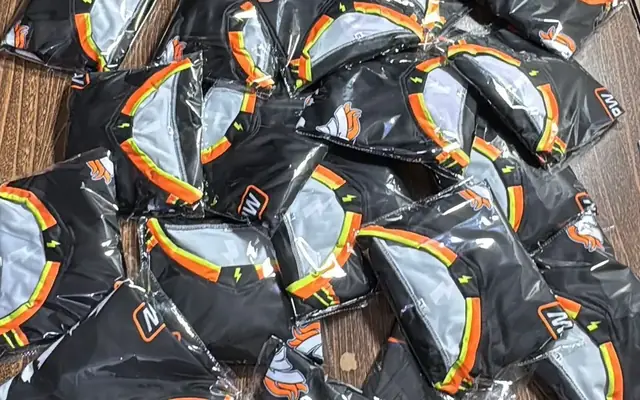
- Do the pre-shipment photos or video show the finished pieces, not just the boxes?
For what happens after packing, including couriers, transit times and import duties, see our guide to shipping sportswear from Pakistan.
Evidence To Ask For At Every Stage
You do not have to take quality on trust, and a reliable factory will not expect you to. Ask for:
- Photos or short videos of the work in progress at the stages above.
- Close-ups of seams, labels and decoration, with a tape measure in frame where size matters.
- A pre-shipment video of the finished order for your sign-off, so you see the goods before they leave.
- Written approval points: a record of what you approved and when, by email or WhatsApp.
Before you sign off, ask yourself three questions. Does every piece I have seen match the approved sample? Are the measurements inside the agreed tolerance? Have I seen the finished goods, not just the process? If any answer is no, raise it in one clear message with photos, before the order ships and while a fix is still simple. Silence is easy to misread as approval, so say what you are accepting as well as what you are rejecting.
If you want an independent view, third-party inspection is welcome. Professional inspectors commonly work to an AQL (acceptable quality limit) sampling plan, which sets how many pieces to open from a batch and how many defects are acceptable. Defects are usually sorted into critical (unsafe or unusable), major (the customer would likely return it, such as a wrong size label, a split seam or a badly misplaced logo) and minor (cosmetic, such as a stray thread). Share your standard with us before production so everyone checks against the same thing, and so you know in advance which defects you will treat as a reject. Our manufacturer buyer's checklist covers the questions to ask before you order.
What This Means At True Fit
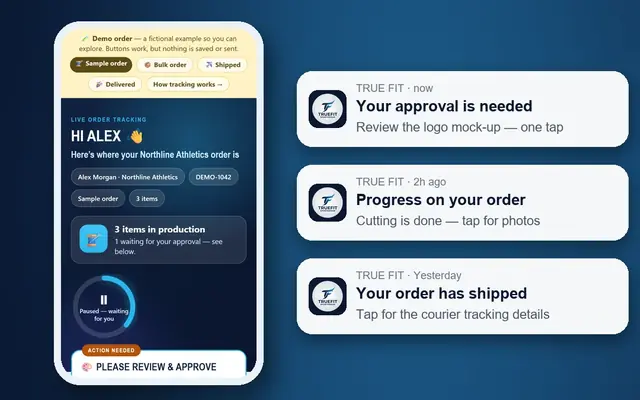
Every order has its own private live tracking page. It shows photo updates as steps are completed, approvals of mock-ups and logo placement before cutting or printing, a separate track for each item, and pre-shipment photos. You can see how it works on our order tracking page or try the live demo.
If any step does not meet our standard, we redo it and tell you, and the tracking page shows when a part was done again. If an item is wrong because of our error, we remake it free of charge, and you cover only the shipping on the redo. If you want something different from what was approved, that is a new sample round on standard terms. You can also leave improvement suggestions on your tracking page, which go to the team that makes your order. For the full process, see our quality control page, and to see the factory itself, visit our factory page.
Frequently Asked Questions
What should I check first on a custom sportswear sample?
Start with the things that are hardest to change later: the fabric and its weight, the overall fit against your size chart, the placement and color of logos and prints, and the labels. Then look at the stitching and finishing. Compare everything against the written specification you approved, not against memory.
Can I use a third-party inspector for my order?
Yes. A third-party inspection is welcome at True Fit Sportswear. Share your own checklist or inspection standard with us before production starts so the inspector and our team are working to the same specification.
What happens if something is wrong with my order?
If an item is wrong because of our error, we remake it free of charge, and the customer covers only the shipping on the redo. If you want something different from what was approved, that is treated as a new sample round on standard terms.
How will I see that quality checks are happening during production?
Every order gets a private live tracking page with photo updates as steps are completed, approvals of mock-ups and logo placement before cutting or printing, a separate track for each item and pre-shipment photos. If a step does not meet our standard we redo it, and the tracking page shows when a part was done again.
More questions? Browse the full FAQ or see how an order moves through our production process.
See what we make in our product range, how a sample lets you check quality before bulk, or the private label, OEM and ODM routes.